
How TikTok Shop Sellers Can Scale GMV with AI, Shoppable Videos and Multichannel Operations
TikTok Shop growth is no longer just about content. The sellers who win are the ones who can connect videos, orders, inventory, ads and fulfilment into one operating system.
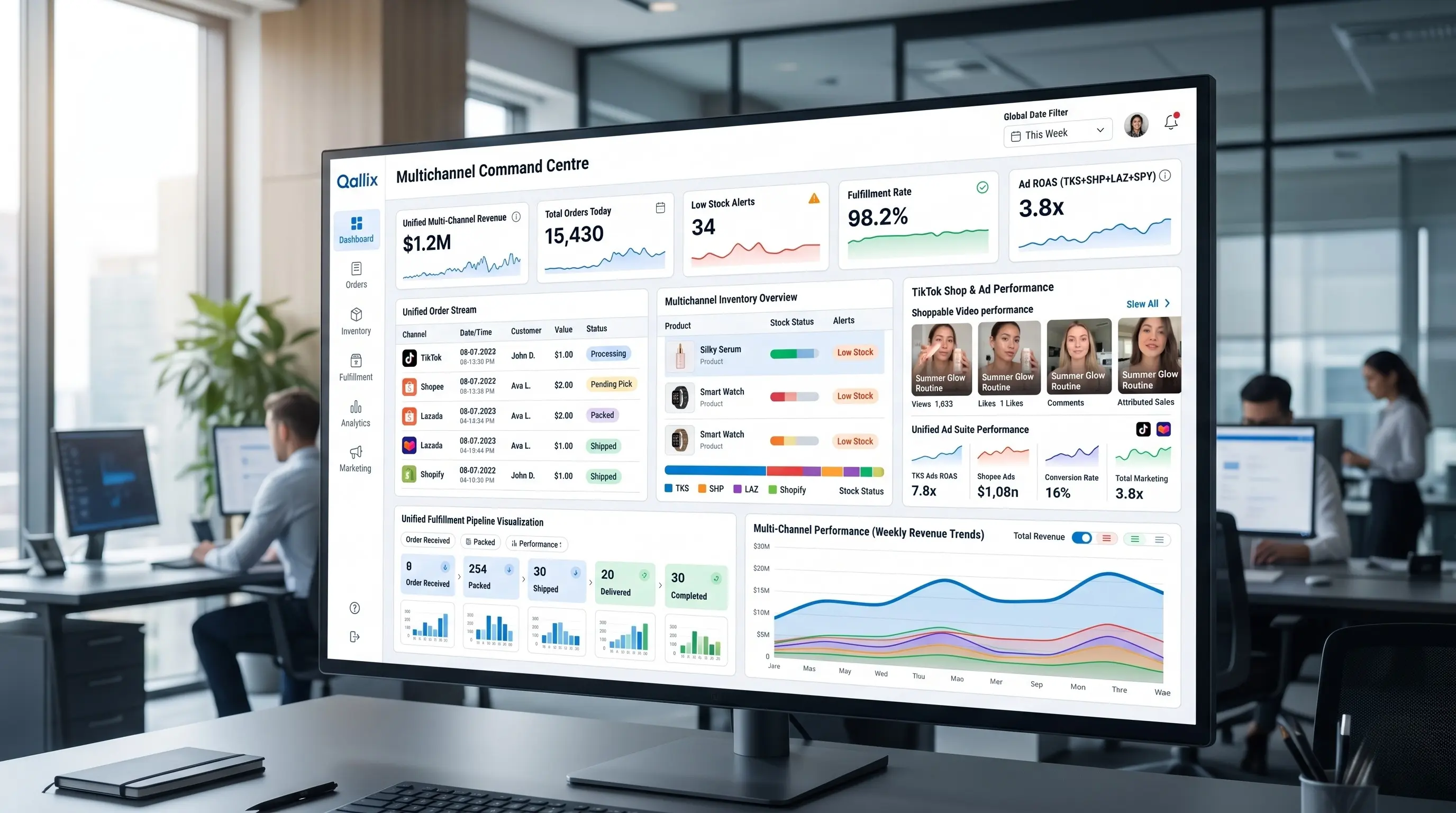
Summary: TikTok Shop has become one of the most powerful sales channels for eCommerce sellers, but growth now depends on much more than posting videos. Sellers need a system that connects content production, ad amplification, order management, inventory accuracy and fulfilment. This guide breaks down how to build that system and where Qallix fits into the full TikTok Shop growth engine.
The real problem is not traffic. It is execution.
Every seller already knows that TikTok can drive attention. The harder question is whether the business is operationally ready to absorb that attention when it turns into orders.
That is where many brands get stuck. They can produce a few videos. They can run a few live sessions. They can test a few ads. But when TikTok Shop starts becoming a serious revenue channel, the workload changes completely.
Suddenly, the team has to create content every day, monitor which videos are converting, check whether hero SKUs are still in stock, handle affiliate creatives, run GMV Max Ads, process orders quickly, manage returns and keep pricing consistent across multiple marketplaces.
That is not just a marketing problem. It is an eCommerce operations problem.
When content volume increases but backend operations remain manual, growth becomes messy. Orders are missed. Stock gets oversold. Pricing decisions become reactive. Campaigns are forgotten. The team spends more time jumping between tabs than actually growing the business.
This is why TikTok Shop success should not be treated as a standalone content strategy. It should be treated as part of a connected commerce system.
The new TikTok Shop growth loop
Based on the webinar structure, TikTok Shop growth can be simplified into one practical loop:
- Short videos create discovery.
- Teaser videos drive viewers into live sessions.
- Live streams convert attention into orders.
- Shoppable videos continue selling after the live session ends.
- GMV Max Ads amplify the content that already shows sales potential.
This loop matters because each part plays a different role. Short videos are not just for entertainment. They increase reach, build product familiarity and give buyers repeated exposure. Live streams create urgency, answer questions in real time and convert high intent customers. Shoppable videos then keep selling beyond the live session because the product card is directly attached to the video.
The strategic mistake many sellers make is treating these as separate activities. They post videos without checking stock. They run ads without enough fresh creatives. They go live without a clear post live content plan. They push a hero product without knowing whether fulfilment can handle the next spike.
The better approach is to see TikTok Shop as a complete operating loop. Content pulls attention in. Ads expand reach. Orders create demand signals. Inventory decides what can be scaled. Fulfilment protects the customer experience. Data tells the seller what to do next.
What sellers get wrong when trying to scale TikTok Shop
The common advice is to post more. That is not wrong, but it is incomplete.
Posting more only works when the seller can measure, fulfil and optimise what those posts generate. Otherwise, more content creates more operational noise.
1. They create content without a backend plan
A product video may perform well, but if the product has limited stock, poor margins or inconsistent pricing across platforms, the campaign may not actually improve the business. A viral product can become a fulfilment problem very quickly.
Before scaling video output, sellers should know which SKUs are ready for volume, which have enough stock, which can support ads and which can be fulfilled without slowing down the team.
2. They rely too much on manual tracking
Many teams still track campaign performance, inventory levels, platform orders and fulfilment status across separate systems. The result is slow decision making.
By the time the seller sees that a product is gaining traction, the team may already be behind on stock, packing or ad budget. Fast moving eCommerce channels need fast operational visibility.
3. They treat AI content as a replacement for authenticity
AI generated content is useful, but it should be used with a clear role. The webinar made an important point: real videos are still valuable for best sellers and trust building, while AI videos are useful for testing products, producing variations and scaling content volume.
The strongest strategy is not real content versus AI content. It is knowing when to use each one.
4. They run ads before creating enough creative supply
GMV Max Ads work best when the system has enough videos to learn from. If a seller only has one or two shoppable videos, there is not enough creative variety for meaningful optimisation.
That is why sellers should build a regular creative pipeline. This can include seller owned videos, affiliate content, repurposed live clips, product demos, comparison videos, tutorials and AI assisted content.
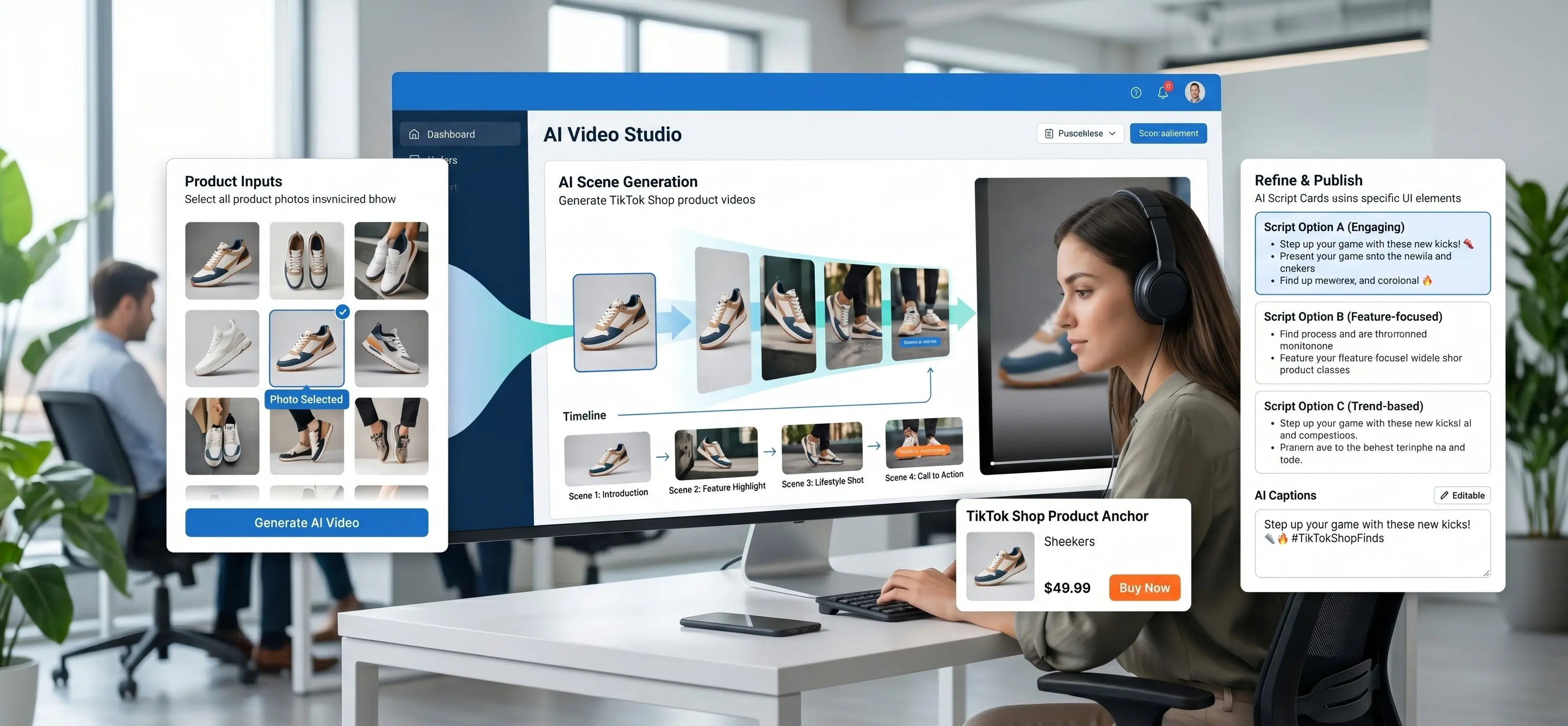
AI video tools change the economics of content production
The strongest shift from the webinar is clear: content creation is becoming less dependent on manpower.
Tools like CapCut, TikTok Symphony and AI video generators allow sellers to produce more variations without starting from scratch each time. Sellers can use product photos, prompts, scripts and templates to generate short content faster.
This matters because TikTok Shop rewards testing. A seller rarely knows which angle will convert until it is posted, measured and compared. One product may perform better with a problem solution angle. Another may need a price comparison. A third may convert through lifestyle usage or a direct demonstration.
AI helps sellers test these angles faster.
The five content formats sellers should build around
From the webinar, there are several content types sellers can use consistently:
- Product demo videos: Show the unique selling points, benefits, usage and price clearly.
- Storytelling videos: Put the product inside a relatable daily life situation.
- Comparison videos: Compare the product with older versions, alternatives or common pain points.
- Tips and tutorials: Teach buyers how to use the product and build trust.
- Production or process videos: Show how products are made, packed or prepared to increase confidence.
For TikTok Shop, the most important creative principle is simple: hook attention quickly and show the product clearly. The first three seconds matter. If the viewer does not understand the value immediately, they will likely move on.
The simple short video formula
A practical formula sellers can follow is:
- Start with a strong hook.
- Show the product benefit immediately.
- Use clear text overlay.
- Add the product anchor.
- End with a direct call to action.
This is not about making overproduced brand films. TikTok native content often works because it feels direct, clear and easy to understand.
Where GMV Max Ads fit into the strategy
Organic content helps sellers discover what works. GMV Max Ads help scale it.
The webinar explained that best selling products can naturally decline after a few months. This is common in fast moving marketplaces because attention shifts, competitors catch up and customers move on to new products.
Ads can help extend the lifecycle of strong SKUs by giving high performing content more reach. But ads should not be treated as a magic fix. They work best when the seller already has strong products, enough stock, competitive pricing and a healthy supply of creatives.
What Product GMV Max is designed to do
Product GMV Max helps sellers run ads for product listings and shoppable videos. It can also boost affiliate generated content when the relevant permissions are in place. That matters because affiliate videos often bring a wider mix of voices, angles and audiences into the sales funnel.
Instead of manually selecting every creative and audience setting, sellers can use GMV Max to let the system optimise towards results. The system needs inputs to work well, which means the seller must keep feeding it with content and ensure the products are actually ready to sell.
How sellers should organise GMV Max campaigns
A practical campaign structure is to group products into three categories:
- Hero SKUs: Best sellers with proven demand and healthy stock.
- Mid performing SKUs: Products with potential but not yet consistent winners.
- New or long tail SKUs: Products that need testing and more exposure.
This prevents sellers from treating every SKU the same. Hero SKUs deserve stronger budget allocation because they already show sales potential. Mid performing SKUs need structured testing. New products need enough creative variety before bigger ad budgets are committed.
The operational question is whether the seller can see all of this clearly. Which SKUs are selling? Which have enough stock? Which videos are driving orders? Which products are being pushed too hard? Which campaign is creating fulfilment pressure?
That is where centralised commerce software becomes important.
Where Qallix fits into the TikTok Shop growth engine
Qallix is built to help sellers manage multichannel eCommerce operations from one place. Instead of switching between TikTok Shop, Shopee, Lazada, Shopify and other tools, sellers can centralise key operations into a single dashboard.
For TikTok Shop sellers, this matters because content and ads are only one side of the growth equation. The other side is what happens after the buyer clicks buy.
Order management
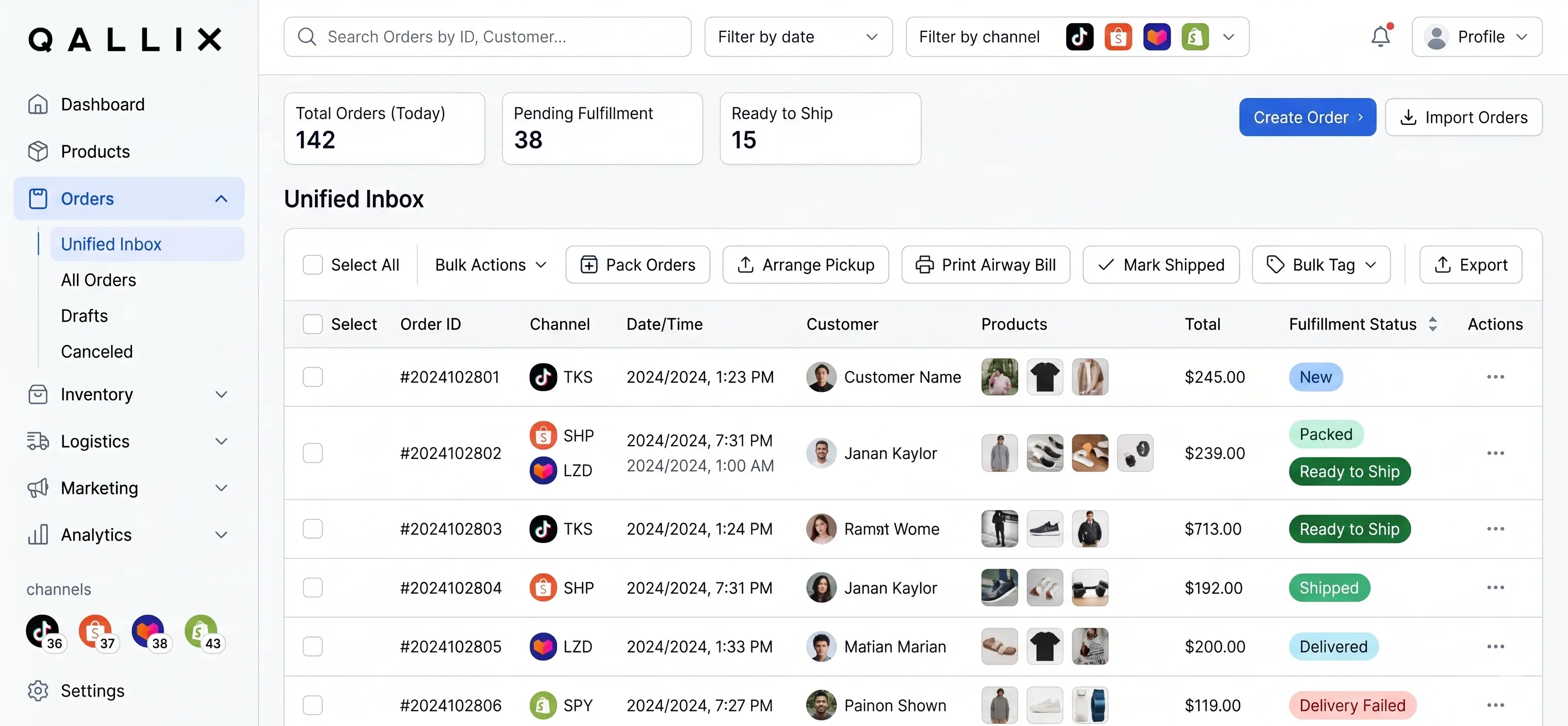
Pull orders from multiple marketplaces into one operating view so the team can process faster and reduce missed orders.
Inventory sync
Keep stock levels updated across sales channels so sellers reduce overselling, stockouts and manual updates.
Fulfilment support
Connect online demand to pick, pack and dispatch workflows so the backend can keep up with campaign spikes.
Reporting and QAI
Use sales and operational data to understand what is working and where the next growth opportunity may be.
1. Qallix connects content driven demand to order operations
When a TikTok video performs, orders can come in quickly. If the team is still logging into each platform separately, the process becomes slow and error prone.
With Qallix features, sellers can manage order flows across marketplaces in one place. This gives the team a clearer view of what needs to be packed, fulfilled or updated.
2. Qallix helps protect sellers from stock mistakes
TikTok demand can spike quickly. A seller may post a product video in the morning and see orders rise by afternoon. If inventory is not synced properly, the seller risks selling products that are no longer available.
Qallix helps sellers centralise inventory and sync stock across connected channels. This is especially important when the same SKU is sold across TikTok Shop, Shopee, Lazada, Shopify and other channels.
3. Qallix makes fulfilment part of the growth system
Fulfilment is often treated as something that happens after sales. In reality, fulfilment is part of the sales engine. If delivery is slow, orders are mishandled or returns are messy, the seller pays for it through poor customer experience and weaker platform performance.
Fulfilment by Qallix helps sellers connect storage, order processing and delivery support into the broader eCommerce workflow. This gives growing brands a way to scale without building a full internal fulfilment team from day one.
4. Qallix gives sellers a clearer view of what to scale
Data is only useful when it leads to a decision. Sellers do not need more scattered dashboards. They need clarity.
Which product should receive more creative testing? Which SKU is declining? Which campaign is creating fulfilment pressure? Which marketplace is producing the strongest demand?
With Qallix reporting and QAI support, sellers can move from guesswork to structured decision making. The aim is not to overwhelm the team with more data. The aim is to show the next best operational move.
A practical operating system for TikTok Shop sellers
Here is a practical way to put everything together.
Step 1: Classify your SKUs
Before posting more videos or running more ads, separate your products into hero SKUs, mid performing SKUs and testing SKUs. Hero SKUs should have enough stock, healthy margins and clear fulfilment readiness. Testing SKUs can be supported with AI generated videos and smaller content experiments.
Step 2: Build a weekly creative rhythm
Do not rely on random content inspiration. Build a weekly rhythm around product demos, comparisons, testimonials, tutorials, lifestyle usage and live stream teasers. Repurpose live clips into shoppable videos where possible.
AI tools can help create more variations, but the content should still feel natural. Avoid overly polished visuals that look fake. Use realistic scenes, simple language and product first storytelling.
Step 3: Add product anchors to the right videos
Shoppable videos reduce friction because users can move from content to product page quickly. Sellers should make sure the product anchor is relevant, the product page is clear and the price matches the campaign message.
Step 4: Use ads to scale proven signals
Once certain videos or SKUs show traction, GMV Max Ads can help amplify them. Sellers should keep campaign structure clean, follow system recommendations where practical and ensure there are enough fresh creatives for the system to test.
Step 5: Watch inventory before increasing spend
Before increasing ad budget, check whether the stock is ready. Scaling a campaign without stock discipline can lead to overselling, cancellations and wasted spend.
Step 6: Connect fulfilment early
If fulfilment is already stretched, TikTok growth will make it worse. Sellers should make sure pick, pack, dispatch and returns processes are ready before campaign traffic increases.
Step 7: Review performance weekly
Look beyond views. Track orders, conversion, inventory movement, fulfilment speed and SKU performance. The best content strategy is the one connected to real business outcomes.
How Qallix helps: Qallix gives sellers one place to manage orders, inventory, fulfilment and reporting across multiple channels. This allows TikTok Shop growth to connect directly to daily operations instead of creating more manual work for the team.
The final takeaway: TikTok Shop growth belongs to sellers who can operate fast
TikTok Shop has changed what eCommerce growth looks like. The winners are not always the sellers with the biggest teams. They are the sellers who can test faster, process faster, restock faster and make better decisions from their data.
AI video tools make content production easier. Shoppable videos make conversion smoother. GMV Max Ads make reach more scalable. But none of that works properly if the backend cannot keep up.
That is why the next phase of eCommerce growth is not just about better marketing. It is about connected operations.
If your team is selling across TikTok Shop, Shopee, Lazada, Shopify or other marketplaces, the real question is not whether you should post more content. The real question is whether your business can handle the sales engine you are trying to build.
In simple terms: More videos create more attention. More ads create more reach. But Qallix helps connect that demand to the operations that make growth sustainable.
Ready to connect your TikTok Shop growth with your backend operations?
Qallix helps sellers centralise orders, inventory, fulfilment and insights across major eCommerce channels, so your team can scale without drowning in manual work.
Sell across channels without losing control of your operations.
Qallix brings order management, inventory sync, fulfilment and reporting into one multichannel eCommerce operating system.
Recommended next reads
How to Get Started with Qai — Your AI Co-Pilot for Multichannel Selling
Before you can chat with Qai, two things need to happen: your platforms must be connected, and your products must be mapped. Here's exactly how to do it.
Read article →eCommerce Business SetupWhy 90% of eCommerce Startups Fail (And How to Avoid It)
Most eCommerce startups don't fail because of bad products — they fail because of avoidable operational and strategy mistakes. Learn the most common pitfalls and how to sidestep them.
Read article →Marketing & Sales StrategiesThe Power of Blogging for eCommerce
Blogging isn't just for media companies. For eCommerce brands, a content strategy can drive organic traffic, build authority, and convert readers into buyers.
Read article →